
How to Spot a Counterfeit Bill
Posted in Fraud & Security
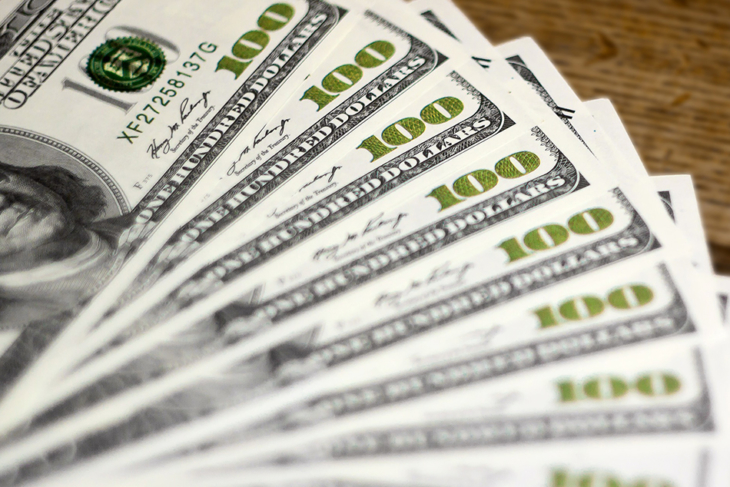
Everyone loves a stash of cash — unless it’s fake. Counterfeiting technology has become increasingly sophisticated so the US Treasury has also upped its game with built in security features. Look for these signs to help you determine if it’s the real thing:
- When held up to light, a watermark is clearly visible on both sides of a genuine bill.
- A genuine bill of $5 or more has a security thread that runs from the top to bottom of the bill. For $10 and $50 bills the thread is on right side of the bill face; it’s on the left side for $5, $20, and $100 bills.
- A genuine bill of $5 or more uses color shifting ink. On a legitimate bill the color will shift from gold to green or green to black when tilting it back and forth.
- Since 2009, a genuine $100 has a blue ribbon woven into the paper. When you tilt the bill up and down, the bells and the “100’s” move from side to side. When you tilt it side to side, they move up and down
- The portrait on the bill is printed very slightly higher than the surrounding area. You should be able to feel a subtle difference.
- When held up to an ultraviolet light, authentic bills will glow: $5 bills glow blue, $10 bills glow orange, $20 bills glow green, $50 bills glow yellow and the $100 bill glows red. (Cool!)
- Look for very fine printed lines in the border of the bill on both the front and the reserve.
- Legitimate US currency is printed on paper made of 75% cotton and 25% linen. This is a fine paper with a substantial “feel”. It is not as smooth as paper used for common office purposes.
What to do if you’ve been passed a counterfeit bill
If a bill you’ve been handed does not pass the authenticity tests, and you believe it’s a counterfeit bill, the U.S. Treasury advises the following course of action:
- Do not put yourself in a position of danger.
- If possible retain the bill and do not return it to the passer.
- If possible, delay the passer with an excuse. Be very careful if you choose this route.
- Take careful note of the passer’s physical appearance and record their vehicle license plate if possible.
- Contact your local police department or call your local Secret Service office.
- Write your initials and date in the white border area of the suspected counterfeit note.
- Handle the counterfeit bill as little as possible. Place it inside an envelope or other protective cover until you can pass it on to an identified Secret Service agent.